
Maintenance
Spring and Fall HVAC Maintenance Checklist for North Carolina Homes
By Littleton Premier Heating & AirUpdated 7 min read
The short answer
Twice a year suits North Carolina homes. In spring, after the pine pollen settles, change the filter, rinse the outdoor coil with the power off, clear the condensate drain and test cooling. In fall, before the first freeze, change the filter, test the heat, watch a heat pump defrost and test your CO detectors.
Why North Carolina Homes Need Two Visits a Year
Around Matthews and Union County most homes use one system for both seasons. A heat pump cools from May to September and heats from November to March, so it runs almost all year. Gas furnaces sit idle through a long humid summer, then have to light on the first cold night. Each season ends with a different kind of wear.
Spring brings the heaviest load on filters and outdoor coils: from late March through April, pine pollen coats cars, decks and every condenser in the neighborhood. Fall is the last calm window before the heating calls start. Booking checks for those two windows avoids the longest waits of peak season.
Spring Checklist: Late April to May
- 1Change the filter once the pollen peak passes, even if you changed it in March.
- 2Rinse the outdoor coil with the power off (see below).
- 3Clear two feet around the outdoor unit: pine straw, leaves, shrubs and grass clippings.
- 4Check the condensate drain and the pan under an attic air handler.
- 5Test cooling on a warm day before you need it. Feel for cool air at the registers within a few minutes.
- 6Look at the insulation on the larger copper line at the outdoor unit. Replace cracked or missing foam.
- 7Test the thermostat schedule and replace batteries.
Rinsing the outdoor coil, power off
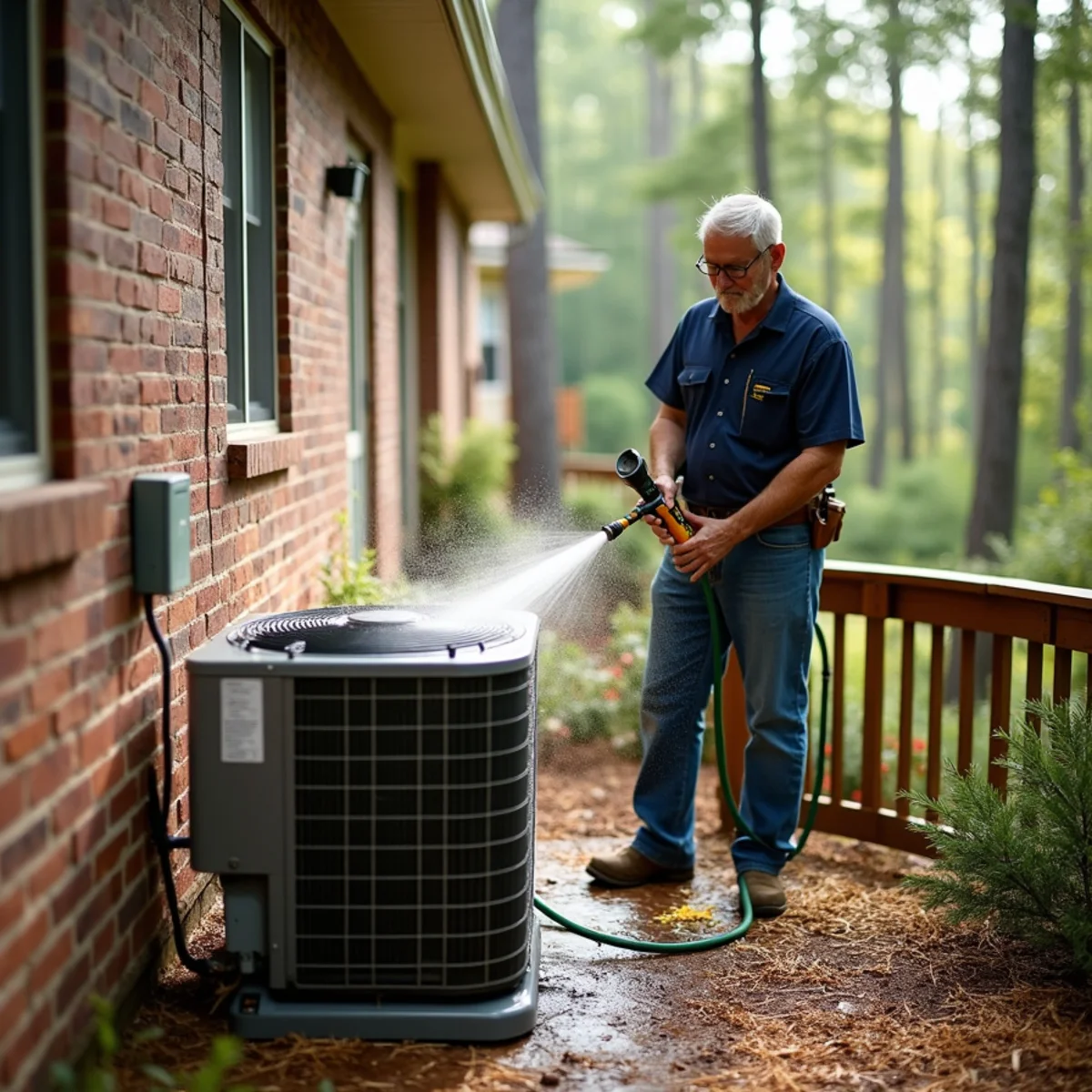
Turn off the outdoor disconnect (the box on the wall near the unit) and the breaker. Use a garden hose with a gentle spray, not a pressure washer, and rinse from the inside of the fins outward where you can reach, or straight in from outside where you cannot. Do not bend the fins and do not open the electrical panel. Let it dry a few minutes before restoring power.
Condensate drains in a humid climate
Piedmont summers pull a lot of water out of the air, and that water grows algae in the drain line. Find the PVC line where it leaves the air handler. Many have a capped tee: pour a cup of plain white vinegar into it, or as your system manual recommends. In the attic, check the secondary pan under the unit. Water or rust there means the main drain is backing up, and a float switch should shut the system off before it overflows into a ceiling.
Fall Checklist: September to Early November
- 1Change the filter before the heat runs for the first time.
- 2Test the heat on a cool afternoon. A light dust smell for the first few minutes is normal; a smell that lingers is not.
- 3Clear leaves from around the outdoor unit and from the outside PVC vent pipes of a high-efficiency furnace.
- 4Watch a heat pump defrost on the first frosty morning (see below).
- 5Test carbon monoxide detectors and replace batteries. Every home with a gas furnace, gas water heater or attached garage should have one on each sleeping level.
- 6Know where the furnace service switch and gas shutoff are before you need them.
Checking a heat pump defrost cycle
On a cold, damp morning a heat pump's outdoor coil collects frost. Every so often it should switch into defrost: the outdoor fan stops, you hear a whoosh, and steam rises off the coil for a few minutes. That is normal. A unit that turns into a solid block of ice, or never seems to defrost, needs a technician. Our guide to a heat pump blowing cold air in winter explains the difference.
If a carbon monoxide alarm sounds or you smell gas, do not investigate. Leave the house, then call 911 and Piedmont Natural Gas (or your gas supplier) from outside. Call an HVAC technician only after the home has been cleared.
Filter Schedule for Piedmont Homes
| Filter type | Normal months | Pollen season, pets or renovation |
|---|---|---|
| 1-inch pleated | Every 1 to 3 months | Every month, sometimes sooner in April |
| 4 to 5-inch media cabinet | Every 6 to 12 months | Check at 3 months |
| Washable or electronic | Clean monthly | Clean every 2 to 3 weeks |
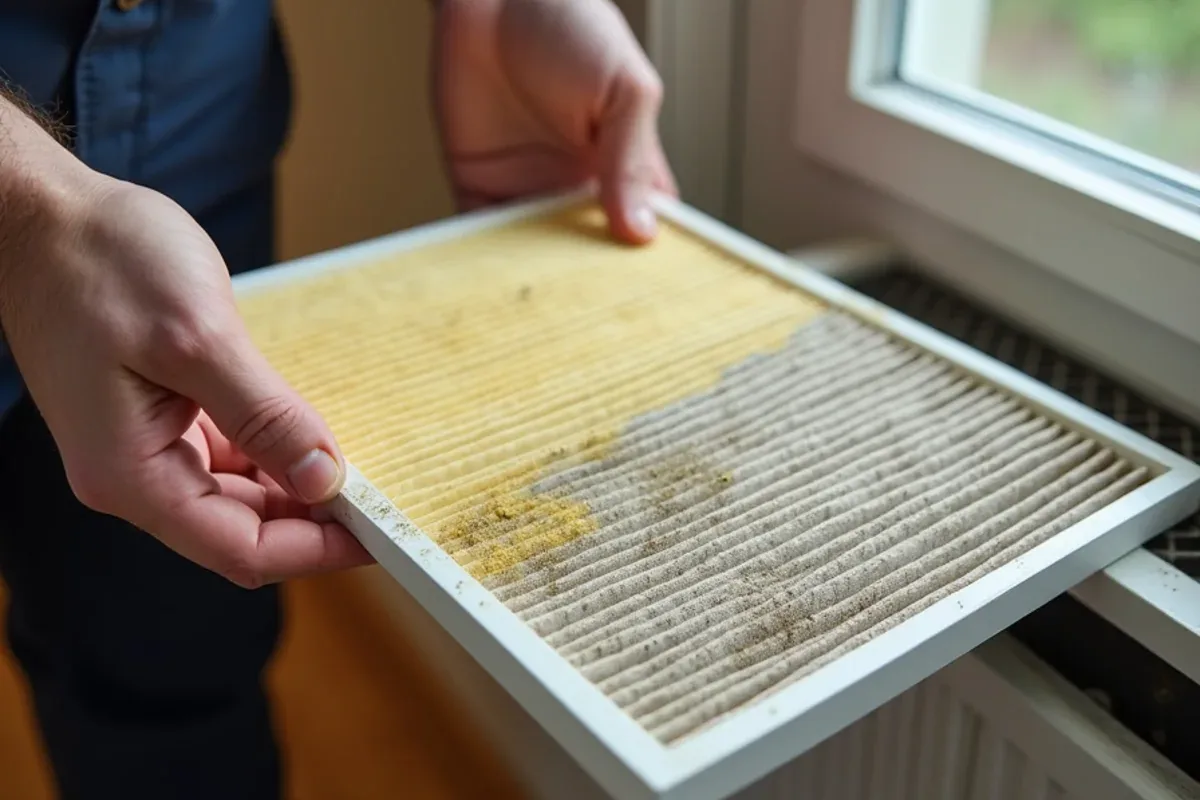
The rule that matters most is to look. Hold the filter up to a light. If you cannot see light through it, change it, whatever the calendar says.
Which MERV rating should you buy?
MERV measures how fine a particle a filter catches. A MERV 8 pleated filter handles pollen and household dust well and suits most systems. MERV 11 catches finer particles and is a reasonable step up for allergies. MERV 13 catches smoke and very fine particles, but in a 1-inch thickness it can choke airflow on an older system with small returns, which is how a coil freezes in July. If you want MERV 13, ask a technician whether your return can handle it or whether a 4 to 5-inch media cabinet is the better route. Higher MERV filters also load faster, so check them more often in pollen season.
What a Professional Tune-Up Should Cover
| Cooling and heat pump (spring) | Furnace and heating (fall) |
|---|---|
| Test the capacitor against its rating | Clean and test the flame sensor |
| Inspect the contactor and tighten electrical connections | Check the igniter and burners |
| Measure refrigerant charge by superheat or subcooling | Test the inducer, pressure switch and limit switch |
| Measure the temperature split across the coil | Inspect the heat exchanger and venting |
| Flush the condensate drain and check the float switch | Check gas pressure and test flue gas for carbon monoxide |
| Clean the outdoor coil and check fan motors | Clear the condensate trap on high-efficiency furnaces |
| Check heat pump defrost controls and reversing valve | Test auxiliary heat strips on heat pumps |
Ask for the readings in writing. Measured numbers, not a checked box, are what a manufacturer looks for in a warranty claim. Our AC repair and furnace and heating repair technicians perform these checks, and heat pump repair and replacement covers defrost and auxiliary heat problems found along the way.
Is a Maintenance Plan Worth It?
A maintenance plan is a prepaid agreement for the spring and fall visits, often with perks such as priority scheduling or repair discounts. It is worth it when it gets the visits done that would otherwise be skipped, and when the terms are clear. Read the agreement before signing:
- What each visit includes, in writing: coil cleaning, drain flush, electrical tests, refrigerant readings, combustion and heat exchanger checks, defrost test.
- Whether "priority" means anything during a heat wave or a freeze, and whether after-hours visits are covered or discounted.
- Whether it covers every system in a two-system home, and whether it auto-renews.
- Whether the manufacturer warranty requires documented maintenance, and that each visit leaves a dated record.
While you are thinking about safety, check the manufacture date printed on each carbon monoxide alarm. Most are designed to be replaced after roughly 7 to 10 years, and many sound an end-of-life chirp; replace any past the date the maker gives.
What to Leave to a Technician
- Anything inside the outdoor unit electrical panel. Capacitors hold a charge after the power is off.
- Refrigerant. Adding it requires EPA Section 608 certification, and a system that needs refrigerant has a leak.
- Burners, gas valves and the heat exchanger.
- Flue pipes and venting.
In older subdivisions in Stallings, NC, many systems are on their second or third replacement, and a tune-up is often where a weak capacitor or a cracked drain pan gets caught before July. If the system has already quit, start with our AC stopped working checklist.
The Bottom Line on Seasonal Maintenance
Change filters on schedule, rinse the coil once the pollen settles, keep the drain clear, and test the heat and the CO detectors every fall. Add a professional tune-up each season and most breakdowns get caught early. To book one, call (321) 478-0693.
From the job site
What Spring and Fall Visits Catch Around Matthews
Spring visits in Matthews and Stallings turn up the same handful of findings year after year: a dual run capacitor reading below its rating, a condenser coil matted with pine pollen and oak tassels, and an attic drain line slowed by algae. Each one is minor in April and becomes a no-cooling call in a July heat wave.
Fall visits find dirty flame sensors, condensate traps clogged over the summer, and heat pumps with weak defrost sensors. Catching those in October is far easier than finding them on the first freezing night, when every technician in the county is booked.
- Book the spring visit after the pollen peak, usually late April.
- Book the fall visit in September or October, before the first freeze.
- Keep the written readings from every visit with your house records.
Related questions
How often should HVAC maintenance be done in North Carolina?
Can I hose off my outdoor AC unit?
How do I know if my heat pump is defrosting correctly?
When should I schedule a tune-up in the Matthews area?
Written by the Littleton Premier Heating & Air team for homeowners in Matthews and nearby communities. General information, not a diagnosis or engineering advice: leave refrigerant, electrical and gas work to a licensed HVAC technician, who has the final word on your system. Every HVAC technician we send is licensed and insured in North Carolina. Last reviewed October 2026.