
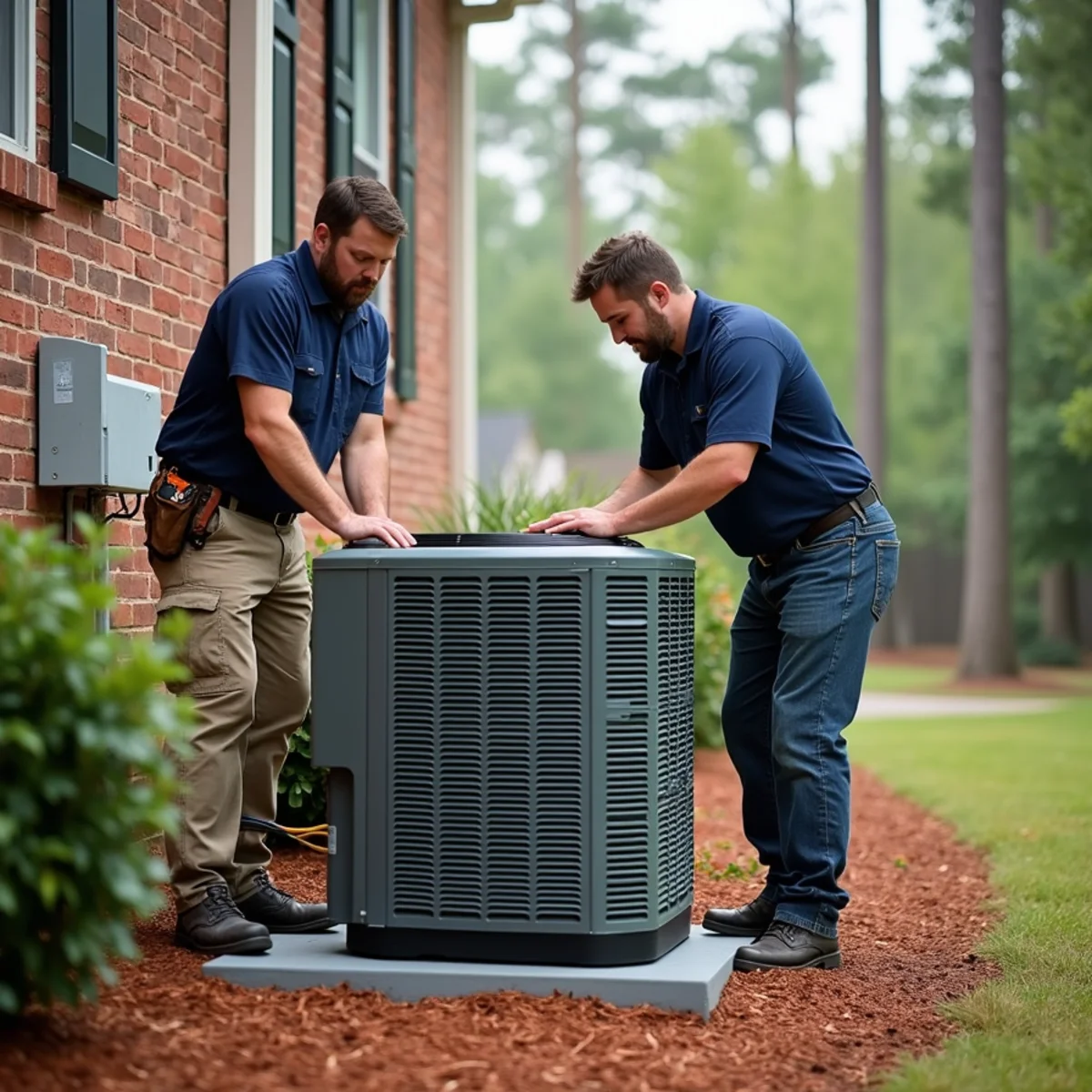
By the Littleton Premier Heating & Air team · Updated
HVAC installation and replacement in Matthews, NC should start with measurements, not a guess from the old unit's label. Call (321) 478-0693, answered 24/7, and we send a licensed HVAC contractor to run a load calculation, inspect the ductwork and electrical, and give you a written quote for a heat pump, gas furnace with AC, dual-fuel or ductless system sized to your house.
Matthews grew from about 1,600 people in 1980 to nearly 13,700 by 1990 and kept building into the 2000s, so a large share of homes in Sardis Plantation, Brightmoor, Providence Hills and the neighborhoods off NC 51 still run equipment from the late 1990s or 2000s. Plenty of those units are on their last few summers. Replacement is a big decision, and you see every line of the price before anything comes out of the attic.
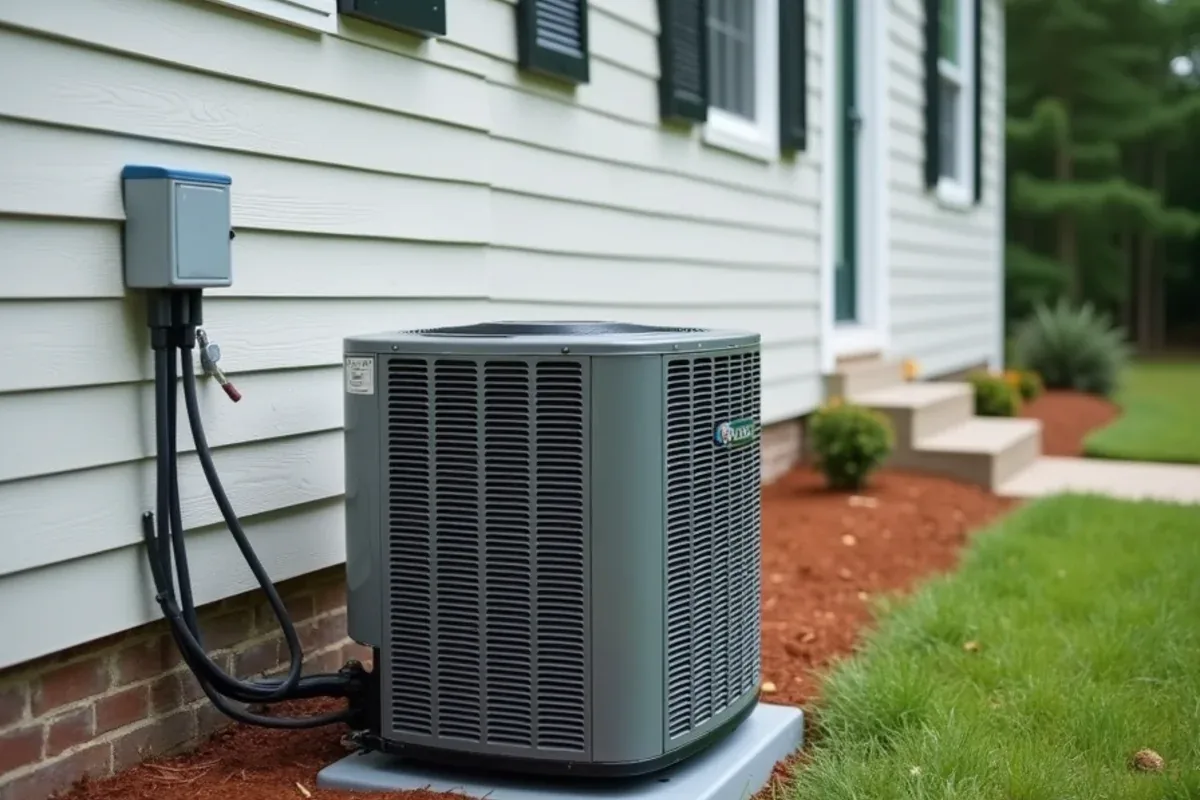
Signs it is time to replace instead of repair
A single failed capacitor or igniter is a repair. Replacement starts to make sense when several of these line up at once:
- Age past about 15 years on an air conditioner or heat pump, or past about 20 on a gas furnace, with repairs turning into a yearly event.
- A major part has failed: the compressor, an outdoor coil that keeps leaking, or a cracked heat exchanger on the furnace.
- R-22 refrigerant. Equipment installed before about 2010 often runs on R-22, which can only be recharged from a shrinking, reclaimed supply because production and import ended on January 1, 2020.
- Humidity the system no longer controls. The thermostat reads 74 but the house feels clammy in July, or the unit runs nonstop through August afternoons.
- Bills climbing with no change in how you use the house, as worn compressors and dirty coils lose efficiency.
- Rooms that never balanced, a sign the original sizing or duct layout was off from day one.
When one expensive repair lands on an older unit, weigh it against the system you would buy anyway in a few years. Our guide to repairing or replacing a 15-year-old HVAC system walks through that math. If the unit is under about ten years old, a targeted AC repair is usually the smarter spend.
System ages in Matthews: why 1990s and 2000s homes are on their second or third unit
The median Matthews home was built around 1994, and most of the town went up between 1985 and 2005. Central air conditioners and heat pumps in the Charlotte area commonly give roughly 12 to 15 years of service, and gas furnaces run somewhat longer because they work only part of the year. Do the arithmetic on a 1990 house: its first heat pump was likely replaced in the mid-2000s, the second is running now, and a third is not far off.
Piedmont weather explains where those numbers land. A heat pump here works both seasons: long cooling runs from June into September under heavy humidity, then heating duty on winter nights at or below freezing. Spring pine pollen cakes outdoor coils in late March and April, and the upstairs air handler in a two-story home bakes in the attic all summer. Systems with clean coils and a correct charge reach the long end of the range; neglected ones fall short of it.
| Home built | Original system usually replaced | What is often there now |
|---|---|---|
| 1985 to 1992 | Around 2000 to 2008 | A second or third system, often R-22 or early R-410A |
| 1993 to 2000 | Around 2008 to 2015 | A second system on R-410A, now 10 to 17 years old |
| 2001 to 2010 | Around 2015 to 2022, or not yet | Original builder-grade units at end of life, or a first replacement |
| 2011 and later | Often still original | R-410A equipment entering its repair years |
Treat the table as a starting point, since every house is different. The serial number on the outdoor unit's data plate usually encodes the manufacture date, and the technician can read it for you on the first visit.
Choosing a system: heat pump, gas furnace with AC, or dual fuel
Three setups cover nearly every replacement in Matthews. Which one fits usually depends on whether Piedmont Natural Gas service reaches the house and how the existing ducts are laid out.
| System | How it heats | Fits well when |
|---|---|---|
| Heat pump with air handler | Moves heat from outdoor air; electric strips back it up on the coldest nights | The home is all-electric, or the current system is already a heat pump |
| Gas furnace with central AC | Burns natural gas; a separate AC handles cooling | Gas is at the house and you like hot supply air on freezing nights |
| Dual fuel | A heat pump carries most heating; the gas furnace takes over below a set outdoor temperature | Gas is available and you want lower winter bills without leaning on strip heat |
Heat pumps are the most common system in post-1990 Matthews homes, and a current variable-speed model handles a typical Piedmont winter well. A furnace replacement fits larger homes already on natural gas. Dual fuel splits the difference: the heat pump runs through mild weather and the furnace takes the hard freezes. For how each behaves in a cold snap, see our page on heat pump repair and replacement.
Two-story homes add one more choice: a single system with zoning dampers, or separate systems for upstairs and down. Many 1990s Matthews houses already have two, and replacing them one at a time is common when their ages differ.
Sizing it right: load calculation, ductwork and humidity control
A proper load calculation follows ACCA Manual J. It accounts for square footage, insulation, window area and orientation, air leakage and local design temperatures, then gives the heating and cooling load room by room. Manual S uses that load to pick equipment that matches it, and Manual D checks whether the ducts can deliver the airflow the new equipment needs.
Skip those steps and a house ends up with a unit one or two sizes too big. In a humid climate that costs more than money:
- Short cycling. An oversized air conditioner drops the temperature fast and shuts off before the coil pulls much moisture out, so rooms feel cold and damp at once.
- Uneven floors. A bigger blower pushing through original ducts gets louder and may still not reach a bonus room at the end of a long run.
- Shorter equipment life, because frequent starts wear compressors and contactors.
Ductwork belongs in the sizing conversation. Many Matthews homes feed the second floor from attic ducts and the first floor from crawl space ducts, and both age. A good replacement quote says whether static pressure was measured and whether any ductwork repair or sealing should happen before the new system goes in. Variable-speed equipment and a dehumidify setting on the thermostat help manage summer humidity, but only when the ducts can carry the air.
SEER2 ratings and the move from R-410A to newer refrigerants
Since January 1, 2023, the Department of Energy rates cooling efficiency in SEER2 and heat pump heating efficiency in HSPF2, using a test closer to real duct conditions than the older SEER and HSPF numbers. North Carolina falls in the Southeast region, where new split systems must meet these minimums:
| Equipment | Minimum rating |
|---|---|
| Central AC under 45,000 Btu/h (under about 3.75 tons) | 14.3 SEER2 |
| Central AC at or above 45,000 Btu/h | 13.8 SEER2 |
| Split heat pump, cooling | 14.3 SEER2 |
| Split heat pump, heating | 7.5 HSPF2 |
Higher ratings cost more up front and pay back over long summer runtimes. In a Matthews house where the AC works hard from June through September, a two-stage or variable-speed unit also tends to hold humidity lower, because it runs longer at low speed. The rating on the box is only reached when the system is matched, sized and charged correctly, so installation quality matters as much as the number.
Refrigerants are changing at the same time. Under the EPA's AIM Act Technology Transitions rule, new residential split air conditioners and heat pumps are moving from R-410A to lower-GWP refrigerants, mainly R-454B and R-32. Both are classed as mildly flammable (A2L), so the new equipment carries leak detection and specific installation requirements. Existing R-410A systems can still be serviced, but supply is stepping down. A new refrigerant usually means a new matched indoor coil rather than reusing the old one, and all refrigerant handling requires EPA Section 608 certification.
Ductless mini-splits for bonus rooms, sunrooms and garages
Plenty of Matthews homes have one room the central system never quite reaches: the finished bonus room over the garage, a sunroom added later, a converted garage or a home office. A ductless mini split installation gives that room its own small heat pump: an outdoor unit, a refrigerant line set through the wall and an indoor head mounted high on the wall or in the ceiling.
- Bonus rooms over garages sit under a hot roof on three sides and at the end of the longest duct run, so they stay warm in summer whatever the main thermostat says.
- Sunrooms carry glass loads the original load calculation never included.
- Garage workshops and additions where extending ducts would mean opening finished ceilings.

A mini-split also gives that room a backup source of heat and cooling if the main system ever fails. Our article on why the upstairs stays hot in two-story homes covers when a mini-split beats rebalancing the ducts.
Installation day: permit, removal, install, startup and inspection
A straightforward replacement usually takes one day, sometimes two when ductwork, electrical changes or a second system are involved. The job typically runs like this:
- 1Permit. In Matthews and Mint Hill, the licensed contractor pulls a mechanical permit from Mecklenburg County Code Enforcement (LUESA) before work starts. On the Union County side, Union County Building Code Enforcement issues permits for most of the county, including Stallings, Indian Trail and Weddington, while Monroe and Waxhaw run their own permit offices. The contractor confirms the right office for your address.
- 2Protection and removal. Floors and the attic path get covered, an EPA Section 608 certified technician recovers the old refrigerant, and the old equipment is disconnected and hauled away.
- 3Install. The outdoor unit goes on a level pad, the indoor coil and air handler or furnace are set, and the line set is replaced or flushed and pressure-tested. A drain pan, float switch and condensate line go in with any attic air handler.
- 4Electrical and gas. Breaker size, disconnect and wiring are checked against the new unit. On a furnace, the gas connection is leak-tested and the venting checked for proper draft.
- 5Evacuation and charge. The system is pulled into a deep vacuum, then charged to the manufacturer's specification rather than by feel.
- 6Startup. The technician records airflow, static pressure, temperature split and refrigerant readings, sets up the thermostat and shows you the filter and settings.
- 7Inspection. A county or town inspector checks the work. Keep the permit card, model and serial numbers and startup readings with your warranty paperwork.
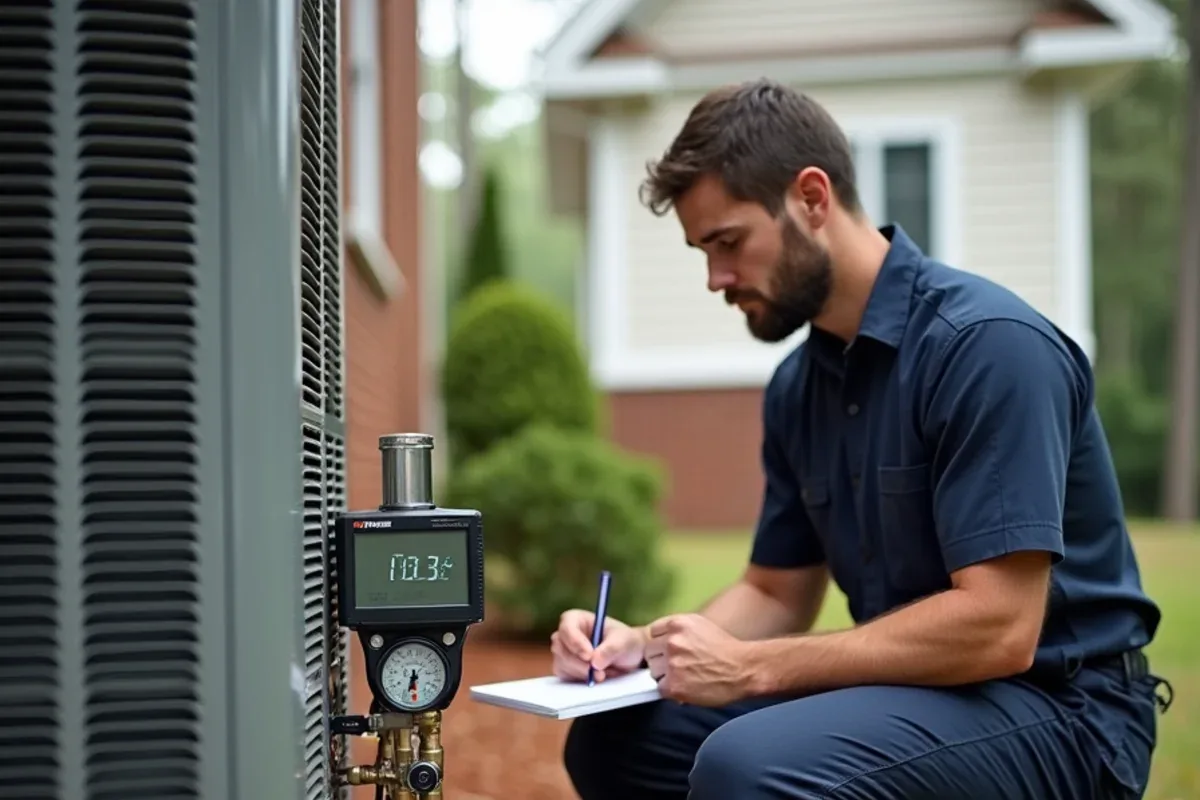
Every HVAC technician we send is licensed and insured in North Carolina. You can look up any contractor on the board's license lookup at nclicensing.org; most residential work falls under the H-3 classification.
When to replace: planning around Matthews seasons instead of a July breakdown
The worst time to buy a system is the day the old one dies in a heat wave. Every installer around Charlotte is booked, equipment in the size you need may be backordered, and the pressure is to take whatever can go in fastest. A replacement planned a few months ahead gets a proper load calculation, time to compare written quotes and a date that suits you.
- March to early May is the calm window before cooling season: mild days, shorter waits, and time to fix ducts in the attic before it bakes.
- October and November work the same way before the first freeze, which matters most for heat pumps and gas furnaces past 15 years.
- Start planning when a system passes about 12 to 15 years, needs refrigerant every summer, or needed a major repair last season. The repair-or-replace guide for 15-year-old systems walks through the decision.
- If it fails in July anyway, a repair that buys a season can be the smarter move, so you can replace on your schedule in the fall. Ask the technician whether that is realistic for your unit.
The first weeks with a new system
A faint warm smell the first time a new furnace or heat strips run is normal and fades quickly. Ask the installer to set the thermostat for the equipment (heat pump changeover, auxiliary heat lockout, fan on Auto), to show you the filter size and where it goes, and to leave the startup readings and the equipment registration confirmation. Book the first maintenance visit for the next spring or fall, and call if any room that cooled before now runs warm, because that usually points to an airflow setting or a duct that needs adjusting, not the new equipment.
What an HVAC replacement estimate and installation include
- A Manual J load calculation instead of sizing from the old unit
- Duct inspection and static pressure readings before equipment is chosen
- A written quote listing equipment, labor, permit, duct work and warranty
- The mechanical permit pulled by the licensed contractor and the inspection scheduled
- EPA Section 608 refrigerant recovery and haul-away of the old equipment
- A new drain pan, float switch and condensate line at any attic air handler
- Startup readings recorded and the thermostat set up with you
- Model and serial numbers recorded for manufacturer warranty registration
Why choose Littleton Premier Heating & Air for hvac installation and replacement
Estimates set up any hour
Call (321) 478-0693 day or night to book an in-home estimate; the line is answered 24/7.
Licensed and insured
Every HVAC technician we send is licensed and insured in North Carolina.
Written quote first
Nothing is removed until you have the full price in writing and approve it.
Sized for Piedmont humidity
Load calculations and duct checks aim for a system that dries the air in July, not one that only drops the temperature.
What affects the cost of a new system, and the utility rebates to ask about
Every replacement is quoted after the load calculation and duct check, and the written quote should separate equipment, labor, permit, duct work and warranty. Ask whether a Duke Energy or Piedmont Natural Gas rebate applies to the equipment on your quote, who files for it, and whether the price shown is before or after it; check the utility's current rebate page, because programs and eligibility change. Federal tax credits for home HVAC equipment have also changed, so check current IRS guidance rather than older advice. What moves the price:
- System type: heat pump, gas furnace with AC, dual fuel or ductless
- Capacity from the Manual J load, and whether one system or two serve the house
- Efficiency level: a minimum-rated single-stage unit versus two-stage or variable-speed
- Refrigerant: R-454B or R-32 equipment and a matched indoor coil
- Duct repairs, sealing or added returns found during the inspection
- Attic or crawl space access, and where the air handler sits in a two-story home
- Electrical upgrades, gas piping or venting changes
- Permit and inspection, thermostat, drain pan and float switch, and haul-away
We don't publish prices we can't stand behind: you hear the price for your system, from the technician who diagnosed it, before any work starts. More detail: New HVAC System Cost in the Charlotte Area: What Drives the Price and Which Rebates to Ask About
HVAC Installation and Replacement around Matthews, NC
Replacement calls cluster where the building booms were: the late-1980s and 1990s subdivisions of Matthews, and the 1995 to 2010 neighborhoods across the Union County line where builder-grade systems are wearing out together. We send installation estimates across our HVAC service areas around Matthews, including AC and heat pump replacements in Stallings, furnace and dual-fuel upgrades in Mint Hill and heat pump replacement in Indian Trail.